
 Tiếng Việt
 English
 中文
中文

Products & Services
5 Factors That Influence Elevator Advertising Rates
Last updated: 14 Sep 2026When planning the budget for an IMC plan, one of the most common questions raised by Chief Marketing Officers (CMOs) and Media Agencies is: “What factors determine elevator advertising rates?” In this article, experts from Focus Media Vietnam share the five core factors that shape elevator advertising pricing, along with budget optimization strategies designed to help businesses achieve the highest possible ROI.
Unlike Digital Advertising, where costs are calculated based on Clicks (CPC) or Impressions (CPM) and can fluctuate from second to second, advertising costs for OOH/DOOH channels in elevator environments are relatively more stable. However, they depend heavily on physical variables and target audience positioning.
Why is it important to understand the structure of elevator advertising rates?
In an Omnichannel advertising campaign, budget allocation requires absolute precision. You are not simply purchasing a location for a screen; you are purchasing attention and exposure time from your target audience within an enclosed environment.
Understanding the factors that influence elevator advertising rates enables strategic planners to:
Avoid wasting budget on areas/buildings that do not match the target audience.
Negotiate the most optimal contract packages based on campaign scale and timing.
Understand the real value behind the numbers: Why can a screen in District 1 be worth three times as much as a screen in an outlying area, even though both screens are the same size?
5 Core Factors That Determine Elevator Advertising Rates
Below are the five main variables that virtually any DOOH service provider uses to establish its standard rate card.
1. Geographic Location & Building Segment
This is the most decisive factor, accounting for approximately 40% of the weighting in the rate structure. In elevator advertising, pricing is determined by “who is viewing the advertisement”, rather than simply “where the screen is located.”
Geographic location (City Center vs. Suburbs): Buildings located in the urban core or CBD (Central Business District), such as District 1 and District 3 in Ho Chi Minh City, or Hoan Kiem and Ba Dinh in Hanoi, consistently command the highest rates. These areas concentrate the headquarters of multinational corporations and experience highly active economic flows.
Building segment:
Grade A office buildings: These locations concentrate C-level executives, senior managers, and high-income office professionals. Advertising rates here are consistently at the top end because of the ability to directly reach business “Decision Makers” in the B2B segment.
High-end residential buildings: Suitable for campaigns involving premium FMCG products, automobiles, real estate, and education.
Shopping malls: A touchpoint immediately before customers make purchasing decisions (Point of Sale).
Mid-range/Affordable residential buildings: Lower costs make these locations suitable for broad-reach (Mass Market) campaigns for fast-moving consumer goods.
Expert perspective: An effective elevator advertising rate strategy is not about choosing the cheapest locations. It is about selecting building segments with the highest density of target customers in order to optimize CPQC (Cost Per Qualified Contact).
2. Foot Traffic & Interaction Density
The second factor that directly affects cost is the total number of people using the elevators each day.
Building scale: An office complex accommodating 5,000 employees will naturally command higher screen placement costs than a standalone building with only 500 employees.
Number of elevators per building: The larger the building, the more elevators it typically has. Traffic is distributed across these elevators, while the total potential Reach remains substantial.
Occupancy Rate: Leading advertising platforms such as Focus Media typically assess the Occupancy Rate of an office building or residential property before incorporating it into their network. A building with an Occupancy Rate above 80% has significantly higher commercial value than a newly completed development.
3. Advertising Frequency and Screen Format
Within elevator environments, two primary advertising formats directly influence the structure of elevator advertising rates: LCD screens and Digital Frame 5.0 screens.
Screen format:
LCD screens: Typically installed in elevator waiting lobbies and capable of displaying dynamic TVCs with sound. Costs are generally higher due to broadcasting bandwidth requirements and their stronger ability to attract attention by engaging both visual and auditory senses.
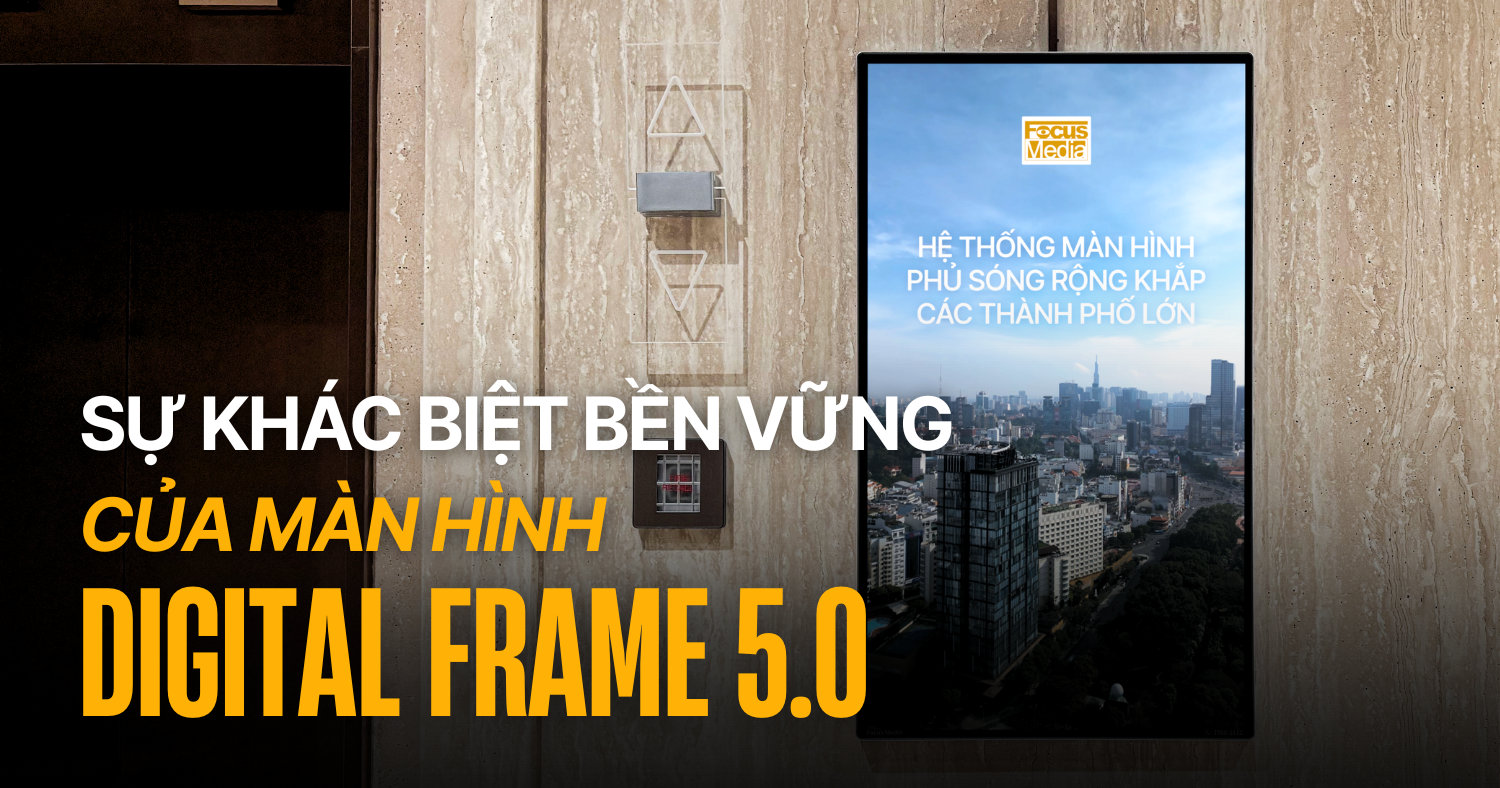
Digital Frame 5.0 screens: Typically installed inside elevator cabins. They display static images or short high-resolution videos and are suitable for communicating core messages and promotional programs.
Advertising frequency (Spots/Day): Elevator advertising does not sell the entire 24/7 airtime exclusively to a single brand. Instead, advertising operates through shared playback loops.
Number of spots/day: Whether you select a package of 60, 120, or 240 plays per day will directly affect pricing. The higher the frequency, the stronger the potential Brand Recall, but the required budget will also increase proportionally.
4. Campaign Timing (Seasonality & Timing)
Similar to television advertising and Digital platforms, OOH advertising in enclosed environments is strongly affected by seasonality.
Peak seasons: Periods leading up to Lunar New Year, Black Friday, International Women’s Day on March 8, Back-to-School season, etc. are when FMCG, F&B, and consumer electronics brands allocate substantial budgets to compete for consumer attention. During these periods, screen inventory becomes scarce, which may result in adjustments to elevator advertising rates or tighter Discount policies.
Low seasons: These typically occur around the middle of the year (May–July). Advertising platforms often introduce promotional packages, provide additional airtime, or offer direct discounts.
Booking urgency: Advance Booking two to three months before a campaign generally secures better rates than urgent Booking made only one to two weeks before campaign launch.
5. Campaign Scale: Number of Screens & Contract Duration
The final factor follows a fundamental economic principle: buying in bulk is generally cheaper than buying individually.
Number of screens: Are you Booking a package of 500 screens covering an entire city, or selectively choosing only 50 screens across several buildings? Large-scale Mass Awareness campaigns are generally eligible for progressive Volume Discounts from media providers.
Campaign duration: A one-week “push sale” campaign will have a higher Rate/week than a long-term Brand Building campaign under a six-month or one-year contract. Long-term packages provide media providers with more predictable revenue, allowing them to optimize elevator advertising rates at the most favorable level for businesses.
Assessment of Factors Affecting Advertising Costs
To help Media Planners and CMOs better understand the relative impact of each factor, the table below summarizes how these variables influence elevator advertising rates:
| Influencing Factor | Impact on Cost | Strategic Note |
|---|---|---|
| Building segment | Very high (30–50% increase) | Prioritize Grade A buildings if the target audience is B2B/High-end. |
| Frequency & duration | High (proportional increase) | A minimum package of 60–120 spots/day is recommended to build Brand Recall. |
| Number of buildings | Medium (discount effect) | Large-volume (Mass) Booking helps reduce the cost per screen. |
| Seasonality | Medium (10–20% increase) | Budgets should be finalized three months in advance for holidays and Lunar New Year. |
| Format (LCD/Digital Frame 5.0) | Medium | Combine both formats to optimize budget and touchpoints. |
3 Tips for Optimizing Elevator Advertising Costs for Businesses
Based on more than five years of experience consulting on OOH solutions for major corporations, below are several tactics that can help CMOs and Media Agencies optimize costs and allocate budgets more effectively.
1. “Mix-Matching” Strategy (Smart Format Combination)
Instead of allocating 100% of the budget to LCD screens across all buildings, apply the 80/20 rule. In main elevator lobbies, where users spend more time waiting, use LCD screens to display TVCs with sound. Inside elevator cabins, use the Digital Frame 5.0 system to reinforce the message through physical retargeting, at a significantly lower cost.
2. Sign a Long-Term Framework Agreement
Instead of making fragmented Bookings for individual short-term campaigns lasting four to six weeks, businesses should work with providers such as Focus Media Vietnam to sign a Framework Agreement. You commit to an overall annual budget—for example, covering four product Launching periods throughout the year.
This allows you to lock in elevator advertising rates at the lowest available level and avoid price increases during peak periods such as holidays and Lunar New Year.
3. Capture the “Low Season”
If your product is not highly seasonal—for example, B2B banking services, SaaS software, or insurance—consider increasing Booking activity during low-season months. With fewer brands advertising during these periods, your message can dominate the elevator environment, maximizing Share of Voice while benefiting from significantly more favorable rates.
Focus Media Vietnam
In today’s market, the greatest challenge for Agencies is not obtaining a low elevator advertising rate, but proving that the price actually delivers measurable ROI.
At Focus Media Vietnam, we are establishing a new benchmark for the DOOH industry:
Pricing Based on Verified Data (NielsenIQ Data): Every quotation from Focus Media Vietnam is supported by independent effectiveness measurement reports from NielsenIQ (NIQ). Clients can understand precisely how their investment translates into percentage increases in brand awareness and purchase-intent conversion. A representative example is the measurement report for the Want Want ice cream campaign, where the budget was effectively optimized as ROI demonstrated clear growth across successive touchpoints.
Intelligent Cloud-Based Management Platform: Pricing goes hand in hand with transparency. Focus Media’s global cloud computing technology enables partners to monitor advertising airtime in Real-time, automate order placement, and generate campaign acceptance reports directly within the system. B2B clients never have to pay for advertising spots that were not displayed.
Exclusive Media Resource Network: With a network covering thousands of Grade A office buildings and high-end residential buildings nationwide, Focus Media provides flexible pricing packages capable of supporting every campaign scale, from pilot campaigns to comprehensive market coverage.
Choosing the right partner with a significant market share does more than optimize elevator advertising rates from an accounting-cost perspective. It also provides an assurance of effectiveness for the entire communications campaign in the digital era.


Comment (0)
Related News



 Contact
Let Focus Media Vietnam
Bring your brand into urban life
Share your campaign objectives. Focus Media Vietnam will advise on how your brand can appear at relevant touchpoints within the building and connect viewers to landing pages, e-commerce platforms, apps, or digital content.

No comments yet. Be the first to share your thoughts.